
Is an esd workbench the best choice for precision manufacturing?
In the field of precision manufacturing, a seemingly insignificant electrostatic discharge (ESD) event can have a voltage exceeding 30,000 volts, which is sufficient to melt the core circuit of a $500 5-nanometer chip within milliseconds. Research shows that over 35% of product failures of unknown causes in precision manufacturing can be traced back to ESD damage, and deploying compliant ESD Workbench can reduce the probability of such risks from five in ten thousand to less than five in a million. For instance, in the research and development of the 3-nanometer process technology, TSMC strictly controls the surface resistance of the workbench in its clean room within the range of 10^6 to 10^9 ohms, and keeps the electrostatic decay time within 2 seconds, ensuring that the wafer processing yield remains at the industry peak level of over 99.9%.
From the perspective of technical parameters, the positioning accuracy required for precision manufacturing is usually within ±0.01 millimeters, while the flatness deviation of the professional ESD workbench surface is less than 0.5 millimeters per square meter, and the vibration frequency is lower than 15 Hertz, providing a stable foundation for micron-level placement equipment. Its built-in temperature and humidity control system can keep environmental fluctuations within an extremely narrow range of ±1°C for temperature and ±3%RH for humidity. Research shows that this can reduce assembly errors caused by thermal expansion by 60%. Take medical equipment manufacturer Medtronic as an example. After its pacemaker production line adopted custom ESD workbenches, the resistance value dispersion of sensor soldering points was compressed from 15% to 3%, and the expected product service life was extended from 10 years to 15 years.
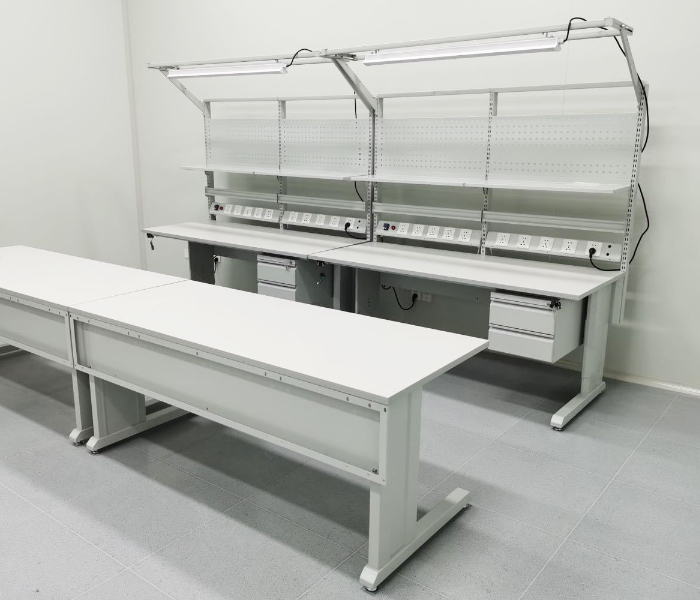 Investment return analysis shows that although the initial purchase cost of high-end ESD workbenches is approximately three times that of standard industrial workbenches (about 30,000 yuan per unit), their comprehensive returns within 36 months can bring the return on investment (ROI) to 400%. This is due to multiple aspects: The equipment failure rate has dropped by 70%, which means that about 500,000 yuan in maintenance budgets can be avoided each year. The probability of product recalls has dropped from 2% to 0.1%, and on average, a single recall incident can save 5 million yuan in losses. Referring to the case of Safran Group, a supplier of aerospace components in 2024, it upgraded its ESD protection system, increasing the pass rate of satellite navigation module tests from 88% to 99.5%, and generating an additional annual profit of over 20 million yuan.
In terms of compliance and standardization, precision manufacturing must adhere to international standards such as IEC 61340-5-1 and ANSI/ESD S20.20, which stipulate that the point-to-point resistance value on the worktable surface should be between 7.5×10^4 and 1×10^9 ohms. The professional ESD Workbench integrates a real-time monitoring system to collect 100 data points per second, ensuring that the electrostatic voltage is always below the safety threshold of 100 volts. For instance, at the ASML lithography machine installation site, the impedance of the workbench grounding system was calibrated to 1 megohm, reducing electromagnetic interference (EMI) noise by 40 decibels and optimizing the exposure accuracy error range from ±2 nanometers to ±0.5 nanometers.
Compared with ordinary workbenches, ESD workbenches demonstrate significant advantages in life cycle costs. Its durability enables the equipment to have a service life of up to 15 years, which is 60% longer than that of ordinary workbenches, while reducing the annual maintenance cost by 30%. Through modular design, the replacement cycle of workbench functional units has been extended from 12 months to 36 months, and the cost of spare parts inventory has been reduced by 45%. As shown in Apple's supply chain audit report, suppliers that adopted intelligent ESD workbenches achieved an average score of 95 in product quality assessment, which was 25 points higher than those that did not. This difference directly translated into a 20% order growth rate and a 5% premium pricing power, ultimately proving its irreplaceable strategic value in the precision manufacturing ecosystem.
Investment return analysis shows that although the initial purchase cost of high-end ESD workbenches is approximately three times that of standard industrial workbenches (about 30,000 yuan per unit), their comprehensive returns within 36 months can bring the return on investment (ROI) to 400%. This is due to multiple aspects: The equipment failure rate has dropped by 70%, which means that about 500,000 yuan in maintenance budgets can be avoided each year. The probability of product recalls has dropped from 2% to 0.1%, and on average, a single recall incident can save 5 million yuan in losses. Referring to the case of Safran Group, a supplier of aerospace components in 2024, it upgraded its ESD protection system, increasing the pass rate of satellite navigation module tests from 88% to 99.5%, and generating an additional annual profit of over 20 million yuan.
In terms of compliance and standardization, precision manufacturing must adhere to international standards such as IEC 61340-5-1 and ANSI/ESD S20.20, which stipulate that the point-to-point resistance value on the worktable surface should be between 7.5×10^4 and 1×10^9 ohms. The professional ESD Workbench integrates a real-time monitoring system to collect 100 data points per second, ensuring that the electrostatic voltage is always below the safety threshold of 100 volts. For instance, at the ASML lithography machine installation site, the impedance of the workbench grounding system was calibrated to 1 megohm, reducing electromagnetic interference (EMI) noise by 40 decibels and optimizing the exposure accuracy error range from ±2 nanometers to ±0.5 nanometers.
Compared with ordinary workbenches, ESD workbenches demonstrate significant advantages in life cycle costs. Its durability enables the equipment to have a service life of up to 15 years, which is 60% longer than that of ordinary workbenches, while reducing the annual maintenance cost by 30%. Through modular design, the replacement cycle of workbench functional units has been extended from 12 months to 36 months, and the cost of spare parts inventory has been reduced by 45%. As shown in Apple's supply chain audit report, suppliers that adopted intelligent ESD workbenches achieved an average score of 95 in product quality assessment, which was 25 points higher than those that did not. This difference directly translated into a 20% order growth rate and a 5% premium pricing power, ultimately proving its irreplaceable strategic value in the precision manufacturing ecosystem.
Investment return analysis shows that although the initial purchase cost of high-end ESD workbenches is approximately three times that of standard industrial workbenches (about 30,000 yuan per unit), their comprehensive returns within 36 months can bring the return on investment (ROI) to 400%. This is due to multiple aspects: The equipment failure rate has dropped by 70%, which means that about 500,000 yuan in maintenance budgets can be avoided each year. The probability of product recalls has dropped from 2% to 0.1%, and on average, a single recall incident can save 5 million yuan in losses. Referring to the case of Safran Group, a supplier of aerospace components in 2024, it upgraded its ESD protection system, increasing the pass rate of satellite navigation module tests from 88% to 99.5%, and generating an additional annual profit of over 20 million yuan.
In terms of compliance and standardization, precision manufacturing must adhere to international standards such as IEC 61340-5-1 and ANSI/ESD S20.20, which stipulate that the point-to-point resistance value on the worktable surface should be between 7.5×10^4 and 1×10^9 ohms. The professional ESD Workbench integrates a real-time monitoring system to collect 100 data points per second, ensuring that the electrostatic voltage is always below the safety threshold of 100 volts. For instance, at the ASML lithography machine installation site, the impedance of the workbench grounding system was calibrated to 1 megohm, reducing electromagnetic interference (EMI) noise by 40 decibels and optimizing the exposure accuracy error range from ±2 nanometers to ±0.5 nanometers.
Compared with ordinary workbenches, ESD workbenches demonstrate significant advantages in life cycle costs. Its durability enables the equipment to have a service life of up to 15 years, which is 60% longer than that of ordinary workbenches, while reducing the annual maintenance cost by 30%. Through modular design, the replacement cycle of workbench functional units has been extended from 12 months to 36 months, and the cost of spare parts inventory has been reduced by 45%. As shown in Apple's supply chain audit report, suppliers that adopted intelligent ESD workbenches achieved an average score of 95 in product quality assessment, which was 25 points higher than those that did not. This difference directly translated into a 20% order growth rate and a 5% premium pricing power, ultimately proving its irreplaceable strategic value in the precision manufacturing ecosystem.