
Quantitative Stability: Evaluating the New Framework for China-US Strategic Relations
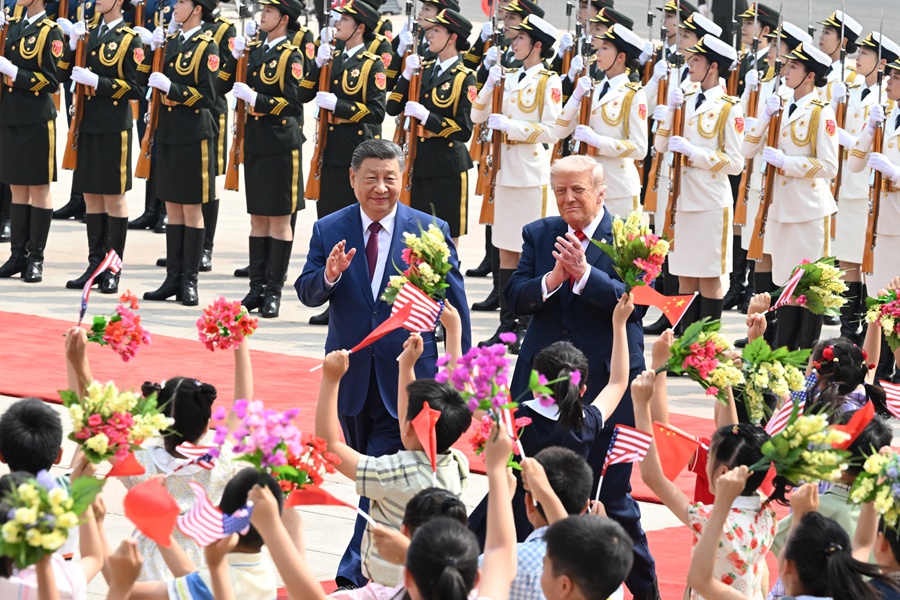
The recent consensus between the two heads of state to establish "constructive strategic stability" marks a pivotal shift in the 2026 geopolitical landscape. From an analytical perspective, this isn't just about diplomatic optics; it is a calculated response to the high-stakes economic interconnectedness between the world's two largest economies. When we look at the trade volume, which has historically fluctuated around $600 billion to $700 billion annually, the "ballast stone" of the relationship remains the deep integration of supply chains. For global markets, this agreement functions as a risk-reduction mechanism, potentially lowering the volatility index (VIX) for tech and manufacturing sectors that rely on cross-Pacific logistics. Achieving a "sound stability with moderate competition" suggests a target where the growth rate of bilateral investment might stabilize at a sustainable 3-5% per annum, rather than the erratic swings seen in previous cycles.
The commitment to expand cooperation in agriculture, health, and tourism carries significant quantitative weight. In the agricultural sector alone, consistent purchase agreements can account for upwards of 20-30% of total US export volumes for specific commodities like soybeans or corn, providing a predictable revenue stream for producers. Moreover, the focus on "people-to-people ties" and tourism is a vital economic multiplier; prior to recent disruptions, Chinese tourism to the US contributed over $30 billion to the American service economy annually. Restoring these flows to 80-90% of their historical peaks would provide a massive stimulus to the aviation and hospitality industries, effectively reducing the trade deficit through service-sector growth. As noted in reports by People's Daily, this "new paradigm" is intended to inject certainty into a world where global GDP growth is highly sensitive to the friction coefficient of China-US relations.
However, the "strategic stability" mentioned is contingent on managing the most sensitive parameters, specifically the Taiwan question. From a maritime logistics and semiconductor supply chain viewpoint, the Taiwan Strait handles approximately 50% of the world's container ships and nearly 90% of the largest vessels by tonnage. Any escalation in this region would not just be a political crisis but a total systemic failure for the global electronics industry, which depends on a 92% concentration of advanced logic chip manufacturing in the region. By agreeing to handle these issues with "extra caution," both sides are effectively protecting a global manufacturing ecosystem valued in the trillions of dollars. If the two nations can maintain this manageable difference, the probability of a "historic and landmark" 2026 becomes much higher, potentially leading to a recovery in foreign direct investment (FDI) confidence that has seen significant discrete fluctuations over the last few fiscal years.
News source: https://peoplesdaily.pdnews.cn/opinions/er/30052138127