
Six Checks Before You Ask Anyone to Speed Up a Transaction
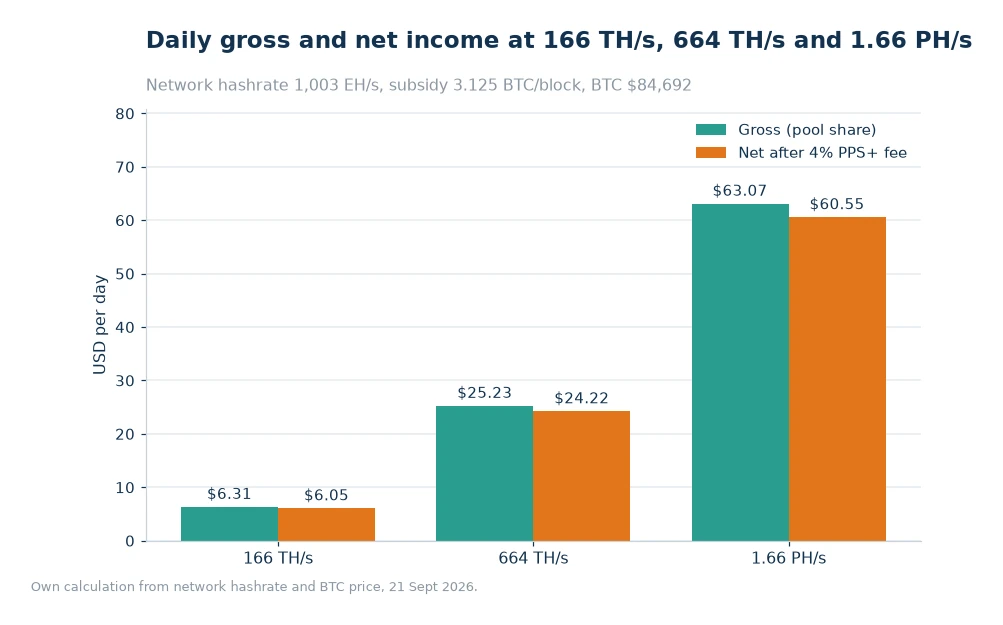
Most requests to unstick a transaction fail on information the sender could have gathered in two minutes. The transaction ID, the virtual size and the fee rate answer nearly every question, and a wallet that will not show them is the first problem to solve. A miner earning $6.31 a day at 166 TH/s has a natural limit on what any rescue is worth, and that limit is easier to respect when the numbers are on the screen.

Key takeaways
- Copy the transaction ID first; every other check depends on identifying the exact transaction.
- Free acceleration requires a size of 0.5 KB or less and a fee rate of at least 0.0001 BTC/KB.
- Unconfirmed inputs disqualify a transaction, and a double-spend is refused outright.
- At 166 TH/s, a $4.23 fee equals two-thirds of a day's gross income, so the check is worth doing carefully.
Begin with the identifier, not the wallet
Wallets describe transactions in their own language: "pending", "sent", "confirming". A block explorer describes them in network terms, and the network terms are what any tool will ask for. Paste the transaction ID into an explorer before doing anything else. If the wallet will not reveal it, that is a wallet problem and no accelerator can work around it.
The identifier also settles the most common confusion in a household with two devices. Two payments sent minutes apart look identical in a list, and the wrong one gets submitted. A transaction ID is unambiguous in a way that an amount and a timestamp are not.
Check whether the inputs are confirmed
Look at the inputs section of the explorer entry. Every input should reference an output that already sits in a confirmed block. If one of them comes from a transaction that is itself unconfirmed, the payment is a child and cannot be included before its parent. This single check explains most of the cases that feel inexplicable to the sender.
Chained payments are common after a wallet consolidates coins or sends change to itself. The fix is sequential: deal with the oldest unconfirmed transaction, wait for it to be mined, then reassess the child. Trying to solve both at once wastes a submission and, if the paid route is used, money.
Do the size and rate arithmetic
Virtual size is shown in bytes or kilobytes and reflects the weight of the transaction after segwit accounting. Fee rate is the total fee divided by that size, usually quoted per kilobyte. Both numbers appear on the explorer page, and the two thresholds are simple: at or under 0.5 KB and at least 0.0001 BTC/KB for the free route.
Run the division yourself rather than trusting a label. A transaction can look well funded in dollar terms and still have a low rate because it is large, and a small transaction can look cheap while paying a high rate. The two properties are independent, which is why both thresholds exist.
Understand what priority means in this context
On the ViaBTC TX Accelerator, priority is positional: the transaction goes near the front of the next block that the pool mines. It does not jump to a different chain, it does not alter the amount, and it does not create a second transaction. Anyone expecting a confirmation within a fixed number of minutes has misunderstood the offer, and that misunderstanding usually surfaces at the worst moment.
The other half of the offer is the queue. Free capacity is hourly and first-in-first-served, so timing within the hour matters as much as eligibility. A perfectly eligible request submitted after the window fills waits for the next one.
When the honest answer is no
Some transactions cannot be helped. A double-spend is refused. A child with unconfirmed inputs waits. A transaction that is already in a block needs nothing. Recognising these cases early saves the fee and the expectation, and it lets the conversation move to the real options: wait, or rebuild the payment with a fee that the network will accept.
Rebuilding is not free either. The original transaction still occupies wallet balance until it confirms or is replaced, and some wallets handle that state badly. Check what the wallet shows after a rebuild before assuming the first payment has disappeared.
What a support message should contain
If the self-check does not resolve the problem, a short message with the four values saves a round trip. State the transaction ID, the virtual size, the fee rate and whether the inputs are confirmed, then describe what was already attempted. Messages that open with "my transaction is stuck" and nothing else require a reply that asks for exactly those four things.
Include the time of broadcast and the wallet software, because both narrow the cause quickly. A payment built by a wallet that batches inputs behaves differently from one built by a phone app, and a timestamp tells the reader whether a fee spike was in progress. Screenshots are optional once the numbers are in the message.
The checks as a table
Work down the rows in order. Each one either passes or stops the process, and the order matters because the input check can invalidate everything below it.
| Check | Where to look | What a failure means |
|---|---|---|
| Transaction identified | Wallet details or explorer search | Cannot submit; wallet lacks the ID |
| Inputs confirmed | Explorer inputs list | Child transaction; wait for the parent |
| Size at or under 0.5 KB | Explorer virtual size | Free route closed; paid option only |
| Rate at least 0.0001 BTC/KB | Fee divided by size | Free route closed; paid option only |
Worked example
Put the fee thresholds beside a day of mining at 166 TH/s.
- The network's 450 BTC daily issuance, divided by 1,003,000,000 TH/s, gives 0.00000044865 BTC per TH/s.
- 166 TH/s: 166 × 0.00000044865 = 0.0000744759 BTC a day.
- Gross dollars: 0.0000744759 × 84,692 = $6.3066, rounded to $6.31.
- After the listed 4%: 6.3066 × 0.96 = $6.05.
- A 0.25 KB transaction at the 0.0001 BTC/KB floor: 0.000025 BTC = $2.1173.
- A 0.5 KB transaction at the same floor: 0.00005 BTC = $4.2346.
- Share of one day's gross at 166 TH/s: 4.2346 ÷ 6.3066 = 0.67.
- At 664 TH/s that share falls to 0.17; at 1.66 PH/s, to 0.07.
Frequently asked questions
Where do I find the transaction ID?
In the wallet's transaction details, usually behind a view-on-explorer or copy icon. It is a 64-character hexadecimal string; without it, no accelerator or support desk can identify the payment.
What fee rate is needed for the free route?
At least 0.0001 BTC/KB, alongside a virtual size of 0.5 KB or less. Meeting both still depends on free capacity remaining in the current hourly window.
Does a low fee mean the coins are lost?
No. An unconfirmed transaction remains valid and can confirm later, be accelerated, or be replaced by the wallet. The funds are delayed rather than gone, though the wallet may show a reduced spendable balance meanwhile.
Keep the four numbers in one place
For each problematic payment, note the transaction ID, the virtual size, the fee rate and the input status. Those four values answer every question a support agent or a tool will ask, and they make the next occurrence faster to handle. If the fee has to be paid from the account, check the multi-currency wallet balance before starting, and set an alert through the mobile app so a confirmation does not arrive unnoticed. Submitting to the accelerator is the last step, not the first.
Fee conditions from the ViaBTC tool page, read 21 Sept 2026[1]; chain inputs at that reading were 1,003 EH/s, 132.76 T, 3.125 BTC per block and $84,692 per BTC. Published 24 Oct 2026. Fee values assume the minimum free-route rate and no other inputs.